












To get around Curitiba, the most practical option for tourists is the integrated bus system, with fares starting at R$ 6.00 and comprehensive coverage. The Tourism Line connects the main tourist attractions for R$ 45.00. Apps like Uber and 99 work well in the city, and car rental is worthwhile for itineraries outside the center.
Planning how to get around in Curitiba is one of the first decisions for those visiting the capital of Paraná, and the good news is that the city offers options for all traveler profiles.
The public transport system is one of the most recognized in Brazil, with articulated buses, tube stations and integration that facilitate displacement even for those who do not know the city.
In addition to public transport, Curitiba has mobility apps, taxis, car rental and the famous Tourism Line, which is aimed especially at those who want to see the city’s main attractions without having to decipher complex routes. Each option has advantages and limitations that depend on the itinerary, budget and available time.
Brasil ATM has gathered updated information on all forms of circulation available in the city to help you choose the best combination for your trip. Throughout this content, you will understand the real costs, the most useful routes and the most common mistakes tourists make when moving around Curitiba.
How to get around in Curitiba
Curitiba has five main forms of transport for tourists: integrated bus, Tourism Line, mobility apps, taxi and car rental. For most urban itineraries, the bus or apps work well. The Tourism Line is the most practical option for those who want to circulate through the tourist points with convenience.
The bus system covers practically the entire city and is the most economical means.
For tourists with an itinerary concentrated on the most well-known attractions, such as the Botanical Garden, the Wire Opera House and Tanguá Park, the Tourism Line eliminates the need to understand conventional routes.
Apps like Uber and 99 work with good coverage in Curitiba and are a practical alternative for night trips or when the bus stop is far away. Conventional taxi still operates in the city, but usually has slightly higher rates compared to apps.
Car rental makes sense especially for those who will combine Curitiba with neighboring destinations, such as Vila Velha, the Coast of Paraná or the Serra da Graciosa. For the purely urban itinerary, traffic and parking difficulties in the center tend to make the car less advantageous.
How much does it cost to get around in Curitiba?
The cost varies greatly depending on the means of transport. The integrated bus fare costs around R$ 6.00 (value subject to adjustment; confirm at URBS). The Tourism Line costs R$ 45.00 for the whole day. Apps like Uber cost between R$ 15.00 and R$ 40.00 for common urban trips.
| Means of transport | Average cost | Best for |
|---|---|---|
| Integrated bus | About R$ 6.00 per trip | Daily displacements, economy and flexible itineraries around the city |
| Tourism Line | R$ 50.00 (boarding valid for 24 hours) | Seeing the main tourist attractions of Curitiba |
| Uber and 99 | Between R$ 15.00 and R$ 40.00, depending on distance and time | Specific trips, group travel and night displacements |
| Taxi | Between R$ 20.00 and R$ 50.00, according to the route | Those who prefer a service available at fixed points or without depending on apps |
| Car rental | From R$ 100.00 per day (not including fuel and tolls) | Exploring attractions outside the center, cities in the Metropolitan Region and the coast of Paraná |
The values above are estimates based on recently practiced rates and may vary according to time, distance and demand. Brasil ATM always recommends confirming prices on official channels or in the apps themselves before traveling.
Curitiba’s bus system: the most efficient public transport in Brazil
Curitiba’s bus system is widely recognized as a reference in urban collective transport in the country. According to URBS (Urbanization of Curitiba), the integrated model operates with more than 340 lines and transports about 1.8 million passengers per day, covering the municipality and part of the metropolitan region.
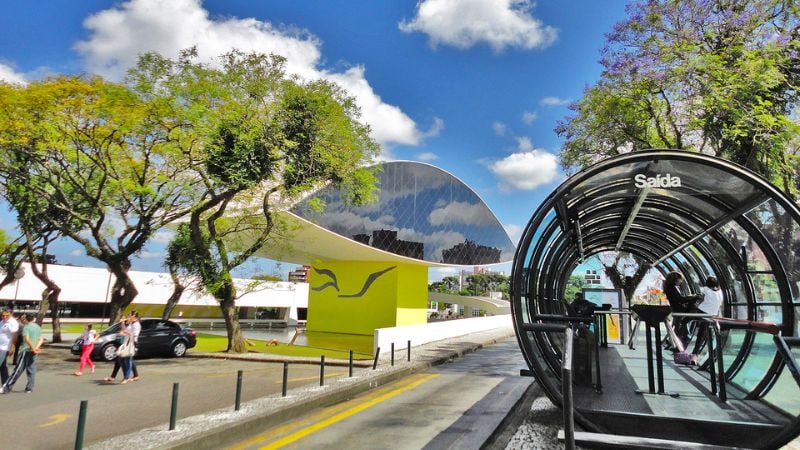
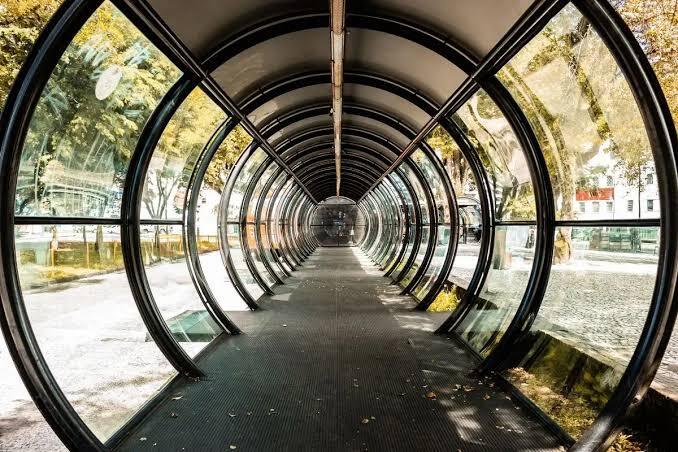
For the tourist, the most visible structure are the tube stations, those cylindrical glass and steel stops that became a symbol of the city. Boarding and fare payment happen inside the station, which greatly speeds up the bus stop time.
How does the bi-articulated bus system and tube stations work?
The system works with high-capacity buses circulating in exclusive corridors, called the Integrated Transport Network (RIT). The passenger pays the fare upon entering the tube station, boards at the same level as the bus and can make connections without paying again within the integrated system.
Bi-articulated buses are the largest in the system, with capacity for more than 250 passengers, and circulate on the express lines of the Streets of Citizenship and the main axes of the city. For the tourist, the most useful lines are those that connect the center to the Botanical Garden, the Santa Felicidade neighborhood and the northern region, where several parks are located.
Integration allows you to board one line, transfer to another within the terminals without paying a new fare, and reach any point in the city with a single fare. This model is what makes Curitiba’s public transport so efficient compared to other Brazilian capitals.
How to pay the fare and use the transport card
Payment inside the tube stations can be made in cash or with the Transport Card, which is rechargeable and works throughout the integrated system. For tourists who will use the bus frequently, the card avoids the need for coins and speeds up boarding.
The Transport Card can be purchased and recharged at points accredited by URBS spread across the city, including bus terminals and some commercial establishments. The minimum recharge value varies; consult URBS for updated information before traveling.
On conventional buses that do not pass through tube stations, payment is made to the conductor inside the vehicle, with cash or card, depending on the line. Be aware because not all conventional lines accept debit or credit cards directly.
Tourism Line: the fastest way to see Curitiba’s tourist attractions
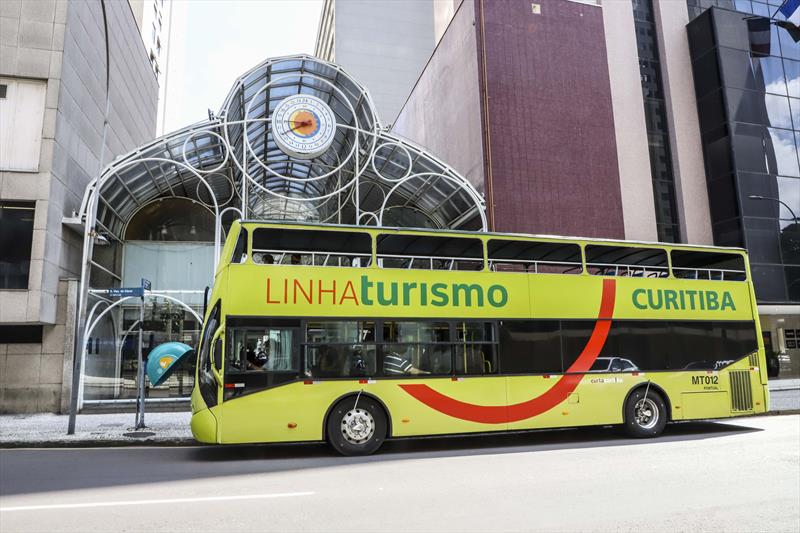
The Tourism Line is an exclusive transport service for visitors, operated with panoramic buses that circulate through the city’s main tourist attractions. For those who have little time or prefer an already structured itinerary, it is the most practical option for tourist circulation in Curitiba.
What is the itinerary, schedules and price of the Tourism Line?
The Tourism Line starts from Curitiba’s historical center, at Praça Tiradentes, and passes through 25 tourist points. The ticket costs R$ 45.00 per person (adult) and allows unlimited disembarkations throughout the day. The buses circulate from 9 am to 5:30 pm, with departures every 30 minutes.
Among the points included in the itinerary are the Botanical Garden, the Wire Opera House, Tanguá Park, the Oscar Niemeyer Museum, the Pope’s Woods and the Santa Felicidade neighborhood. The option to disembark and embark again throughout the day gives a lot of flexibility for those who want to explore some points more calmly.
Children up to 5 years old pay half-price, and there is a discount for students and seniors upon presentation of a document. Values and schedules may change; Brasil ATM recommends confirming information at the Municipal Tourism Institute of Curitiba before starting the tour.
On weekends and holidays, the demand for the service is usually higher. Arriving at Praça Tiradentes in advance avoids queues and guarantees a good seat on the panoramic buses.
Is it worth combining the Tourism Line with walks through the historical center?
It is, especially for those who have at least two days in the city. The Tourism Line covers the parks and more spread out attractions well, but Curitiba’s historical center has interesting points that are closer to each other and are better enjoyed on foot.
Praça Tiradentes, Rua das Flores, Largo da Ordem and the Largo da Ordem Fair on Sundays are experiences that walking provides in a much richer way than the bus. The central area is flat and safe for pedestrians during the day, with wide sidewalks and good signage.
An efficient strategy is to use the Tourism Line in the morning for the more distant attractions, such as the Botanical Garden and Tanguá Park, and reserve the late afternoon to explore the center on foot. This combination makes good use of time without generating excessive tiredness.
How to get to and from Afonso Pena Airport without complication
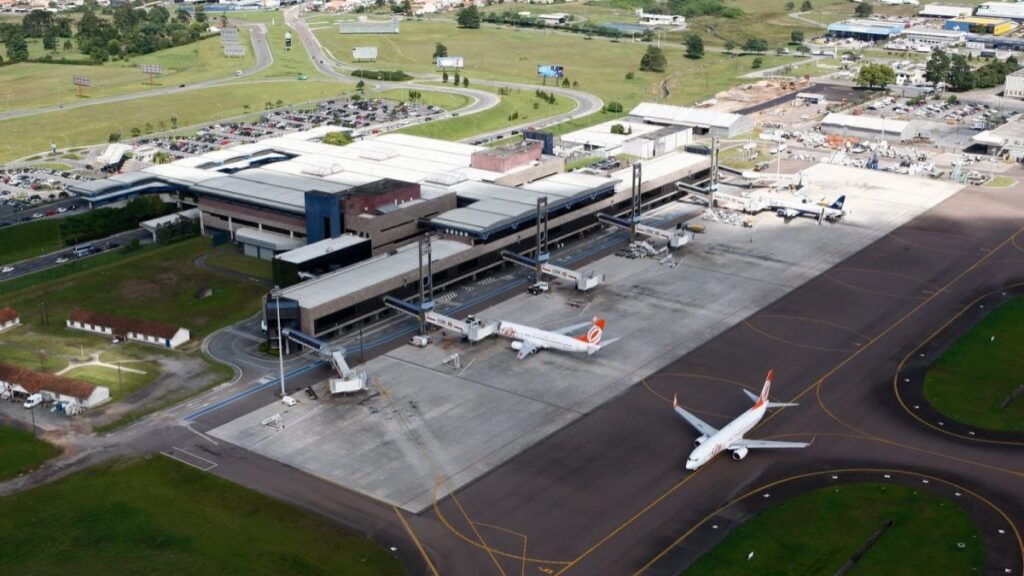
Afonso Pena International Airport is located in São José dos Pinhais, about 18 km from the center of Curitiba. The distance is not great, but the journey can take between 30 and 60 minutes depending on traffic, especially during peak hours.
Bus, taxi or app: which is the best option from the airport to the center?
The Airport-Center Executive bus is the most economical option, with a fare around R$ 18.00 to R$ 20.00 and a direct route to the city center. Apps like Uber and 99 work well at the airport and usually cost between R$ 50.00 and R$ 80.00 to the center, depending on the time and type of vehicle.
| Option | Estimated cost | Average time | Recommended for |
|---|---|---|---|
| Executive Bus | ~R$ 18.00 to R$ 20.00 | 45 to 60 min | Solo traveler or with small suitcase |
| Uber/99 | ~R$ 50.00 to R$ 80.00 | 30 to 50 min | Groups, families, lots of luggage |
| Conventional taxi | ~R$ 80.00 to R$ 120.00 | 30 to 50 min | Those who prefer fixed service and with a receipt |
The Executive bus leaves from the terminal’s arrival area, has regular schedules and goes directly to the center, with few stops. For those arriving with large luggage or in a group, the app tends to be more practical and still comes out cheaper than a conventional taxi.
Avoid accepting transport offers from drivers who approach at the terminal exit without visible credentials. Always use the app or the official line of accredited taxis to ensure safety and a fair price.
Car rental in Curitiba: when is it worth it and how to save
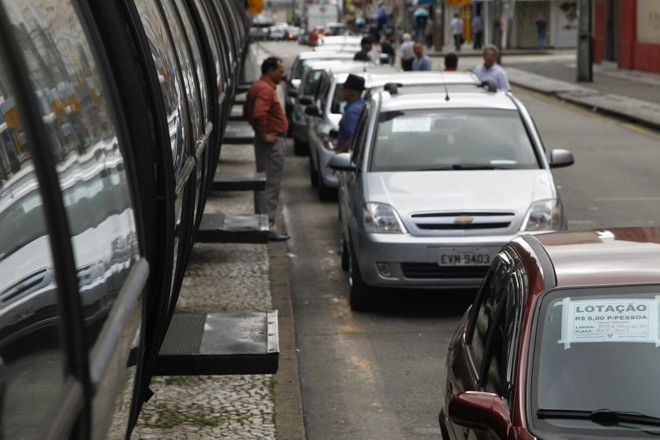
Renting a car in Curitiba makes more sense when the itinerary includes destinations outside the city, such as Morretes, Paranaguá, Ilha do Mel or Paraná’s state parks. To stay only in the urban perimeter, the car rarely pays off: the center has intense traffic at peak hours and paid parking lots that raise the daily cost.
The main rental companies operate at Afonso Pena Airport, which facilitates pick-up upon arrival. Booking in advance, especially on holidays and in the July season, usually guarantees better prices.
Is driving in Curitiba difficult for those from outside?
Curitiba has good signage and the main avenues are wide, which facilitates adaptation. The point of attention is the vehicle rotation system in the center and some one-way streets that can confuse those who do not know the urban layout.
GPS solves most situations well, and navigation apps are updated with traffic restrictions. For those going to the coast or the interior of the state, Paraná’s highways have good general conservation, but it is important to check the conditions of BR-277 and PR-410, which cut through the Serra do Mar and have points with frequent fog.
A practical tip: avoid Curitiba’s center by car between 5 pm and 7 pm on weekdays. Traffic at this time can triple the displacement time on short trips.
Mobility apps and alternatives to own car
Uber and 99 are the most used apps in Curitiba and have good availability both in the center and in the more distant neighborhoods. During peak hours or on days of heavy rain, waiting time may increase, but it rarely exceeds 10 to 15 minutes.
The shared bicycle service Bicicletar, operated by the Municipal Government of Curitiba, has stations in various parts of the city, including near parks and the historical center. For short trips on sunny days, it is an economical and pleasant alternative.
Electric scooters from apps are also available in some regions of the city. Coverage is less comprehensive than car apps, but can be useful for stretches of up to 3 to 5 km within the expanded center.
Common tourist mistakes when moving around Curitiba (and how to avoid them)
Those visiting Curitiba for the first time tend to make some displacement planning mistakes that cost time and money. Knowing these points in advance changes the experience in the city a lot.
Underestimating distances between tourist attractions
One of the most frequent misconceptions is imagining that Curitiba is a compact city where everything is close by on foot. The Botanical Garden, for example, is more than 6 km from the historical center, and Tanguá Park is even further away. Planning the itinerary without considering the displacement time results in rush and unnecessary tiredness.
The solution is to use the Tourism Line for the more distant points and reserve walks for the historical center and Rua das Flores. The Google Maps app works very well for calculating bus routes within Curitiba’s integrated system.
Transport services that few visitors know about
Few tourists know that Curitiba’s integrated bus system includes lines that reach the metropolitan region, such as São José dos Pinhais, Araucária and Pinhais, at no additional cost to the standard fare. For those who are going to explore the city’s surroundings, this is a resource that avoids spending on Uber or car.
Guadalupe terminal, for example, is the starting point for lines that serve neighboring municipalities. Consult the RIT map on the URBS website to see which destinations in the metropolitan region are within the fare integration.
Another little-known service is the Ligeirão, a category of express bus that makes fewer stops and covers the main axes of the city much faster than conventional bi-articulated buses. They are ideal for crossing the city from north to south or from east to west.
For paid attractions, such as the Oscar Niemeyer Museum and the Wire Opera House, buying tickets in advance can avoid queues, especially on weekends and holidays. GetYourGuide offers options for guided tours and tickets for Curitiba with advance booking.
After all, how to get around in Curitiba?
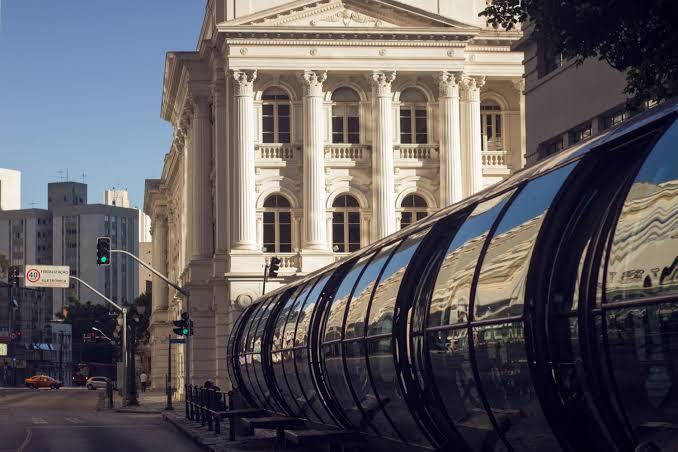
Curitiba offers a transport structure that makes life much easier for the visitor, especially because of the integrated bus system and the Tourism Line. With planning, it is possible to circulate through the city economically and efficiently, without having to depend on a car or spend a lot on apps throughout the entire trip.
Brasil ATM works to keep this information always updated, but rates, schedules and operating conditions may be changed without prior notice. We recommend confirming data on official channels, such as URBS and the Municipal Tourism Institute of Curitiba, before starting the itinerary.
To book accommodation and tours, take advantage of the partners indicated throughout this content and explore everything Curitiba has to offer.
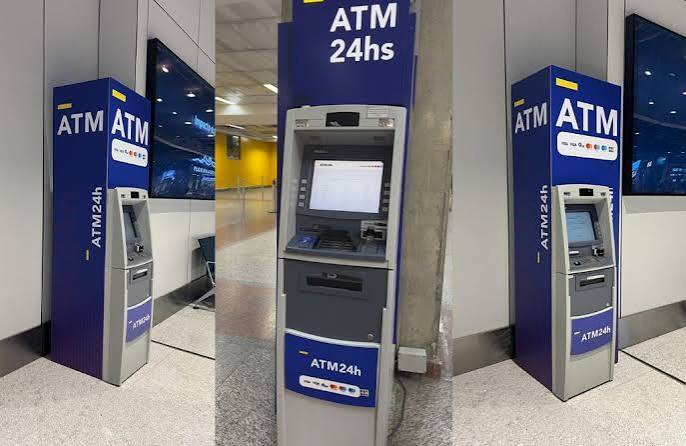
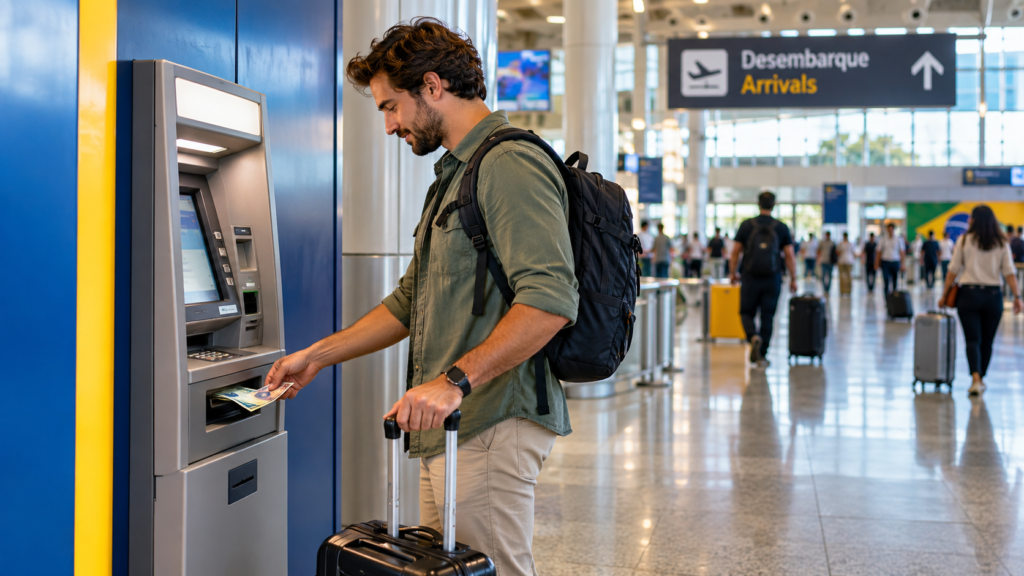
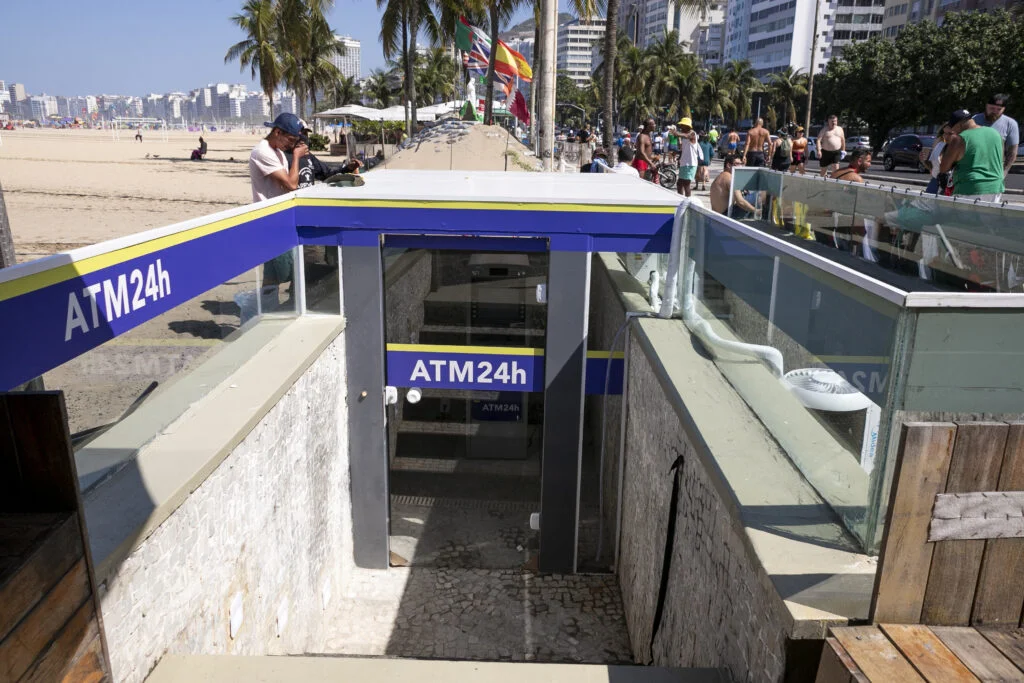
Where to withdraw money at ATM24h machines in Brazil
To make the most of your itinerary through Curitiba, it is better to take cash. This ensures a smooth and amazing experience. In some places, cash is essential for food, transport, tickets to attractions and more.
Check the table below with some 24h ATM machines in the regions mentioned in this article:
| Where | Location |
|---|---|
| Curitiba International Airport | See all points here |
| Jockey Plaza Shopping Center | See all points here |
| Pestana Curitiba | See all points here |
| NH Curitiba The Five | See all points here |
Discover Brasil ATM
At Brasil ATM, we see Brazil as a place full of unique beauties and fascinating culture. Our portal, supported by the global brand ATM24h, reflects our love for Brazil. Our goal is to inspire tourists to explore its wonders in a safe and informed way.
We provide accurate, updated and inspiring information in three languages. With us, you will have everything you need to plan your trip with confidence. We offer travel guides, detailed itineraries and useful planning tips, want to create memories that last. We will show you the natural and cultural beauty of Brazil. Explore famous destinations like Rio de Janeiro and São Paulo, and discover hidden gems like Lençóis Maranhenses and Fernando de Noronha. We are here to help you make the most of your trip.

You might also like to read:
- Public transport in Curitiba: Practical guide for tourists
- Best Hotels in Curitiba: Selection with the highest-rated options
- What to do in Curitiba: 1, 2, and 3-day itineraries + practical tips
- Where to stay in Curitiba: Best neighborhoods and hotels by profile and budget
Frequently asked questions
Curitiba does not have a subway. The city has the Green Line of bi-articulated buses, which works as a BRT (Bus Rapid Transit) in an exclusive corridor and connects the center to peripheral neighborhoods with agility similar to a surface subway. For the tourist, the integrated bus system replaces this function well.
Yes. Curitiba’s integrated system covers practically the entire city and a large part of the metropolitan region. For tourists, it is possible to reach almost all the main attractions using the bus, with a single fare per trip within the integration. The Tourism Line complements public transport well for those who want a more directed itinerary.
Yes. Uber and 99 have good coverage in Curitiba, including Afonso Pena Airport and the more distant neighborhoods. During peak hours or on rainy days, waiting time may increase, but the service works reliably in most of the city.
The journey from Afonso Pena Airport to the center of Curitiba takes between 30 and 60 minutes, depending on the means of transport and traffic. The Executive bus takes around 45 to 60 minutes. Uber and taxi can make the trip in less time outside peak hours.
The Tourism Line operates from Tuesday to Sunday, including national holidays, with departures from Praça Tiradentes from 9 am to 5:30 pm every 30 minutes. On Mondays, the service usually does not work. Brasil ATM recommends confirming the schedules at the Municipal Tourism Institute of Curitiba before planning the tour.