














How much do ATM withdrawal fees cost in Brazil? The amount varies depending on the card issuer, account type, network used, and transaction terms. The withdrawal may be included in a free allowance or involve fees and other costs. Therefore, there is no single amount for all users.
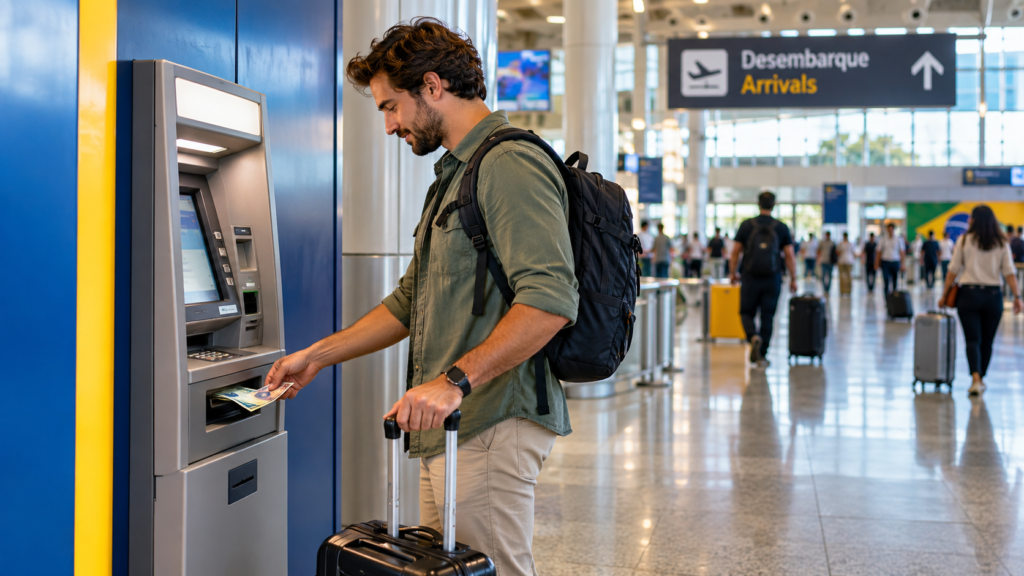
Imagine arriving in Brazil, finding an ATM at the airport, and withdrawing Brazilian reais for your first expenses. Having cash available meets a travel need, but a question may arise: how much will be deducted from your account beyond the amount you receive?
At Brasil ATM, we recommend checking these terms before landing. This allows you to plan your budget, identify possible charges, and choose how to use your money during your trip.
For those using a Brazilian account, the main consideration is usually the withdrawal allowance and the fee for each additional transaction. With a card linked to an account in a foreign currency, you also need to check currency conversion and the terms for international transactions.
As a concrete reference, the Banco Central fee lookup lists, for Banco do Brasil, a maximum fee of R$ 6.50 for an ATM withdrawal, with an effective date of April 29, 2026. This amount corresponds to the service listed in that table and does not represent a mandatory charge for every withdrawal or a fee charged by ATM24h machines.
Throughout this guide, Brasil ATM explains which costs may arise, who sets each charge, and how to reduce expenses whenever your account terms allow it.
Who sets the withdrawal fee?
The card issuer sets the fees related to using the card and account. However, the total cost of a withdrawal may also involve charges from other participants, such as the ATM operator or the provider responsible for currency conversion.
It is useful to distinguish these amounts. The fee charged by the bank for withdrawing money is not necessarily the same as a possible charge displayed by the ATM.
The card issuer is the institution responsible for your card. It sets terms such as withdrawal fees, free allowances, daily limits, and possible charges for international transactions.
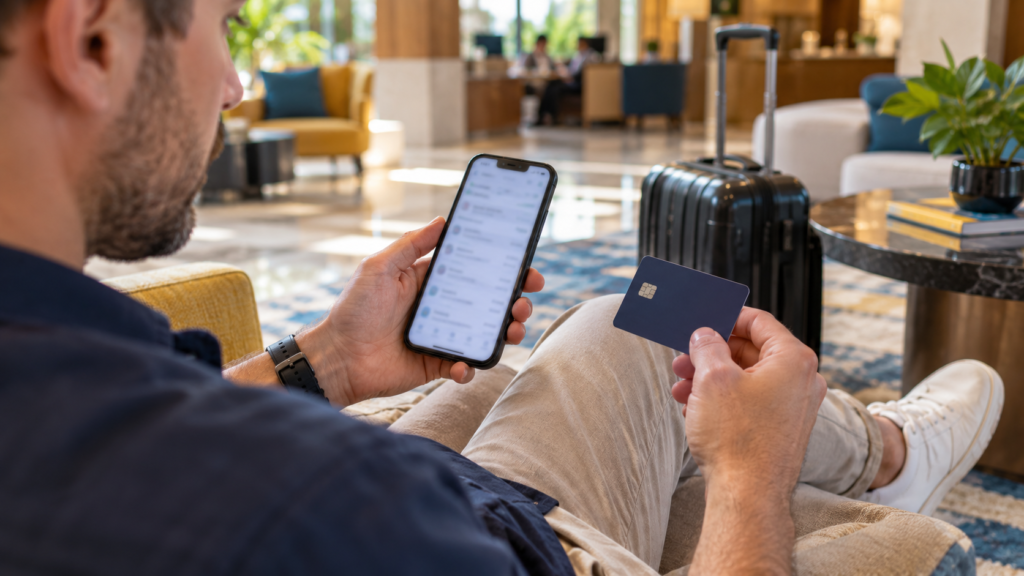
A global account also has its own rules. Holding a balance in dollars, euros, or another currency does not mean that every withdrawal in Brazilian reais will be free. You need to check both the withdrawal and the conversion of your balance.
The card network, such as Visa or Mastercard, participates in processing the transaction. Its name helps verify compatibility but does not, on its own, tell you how much the cardholder will pay.
The account agreement and service package complete this assessment. Two customers at the same institution may have different costs because they use different products, plans, or allowances.
| Cost | Who sets it |
| Issuer’s withdrawal fee | Bank or institution responsible for the card |
| Possible ATM operator fee | Network operator, according to the transaction terms |
| IOF, when applicable | Brazilian legislation |
| Currency conversion | Institution, card network, or provider responsible for conversion |
| Exchange rate spread or markup | Provider responsible for the exchange rate used |
| Additional fees and charges | Financial institution, according to the agreement |
Therefore, simply asking “what is this ATM’s fee?” may not clarify the full cost. A more useful question is: “how much will my account charge for this withdrawal, considering every step?”
What costs may arise when withdrawing cash in Brazil?
Depending on the card and account used, a withdrawal may involve a per-transaction fee, currency conversion, an exchange rate markup, a possible operator charge, and applicable taxes.
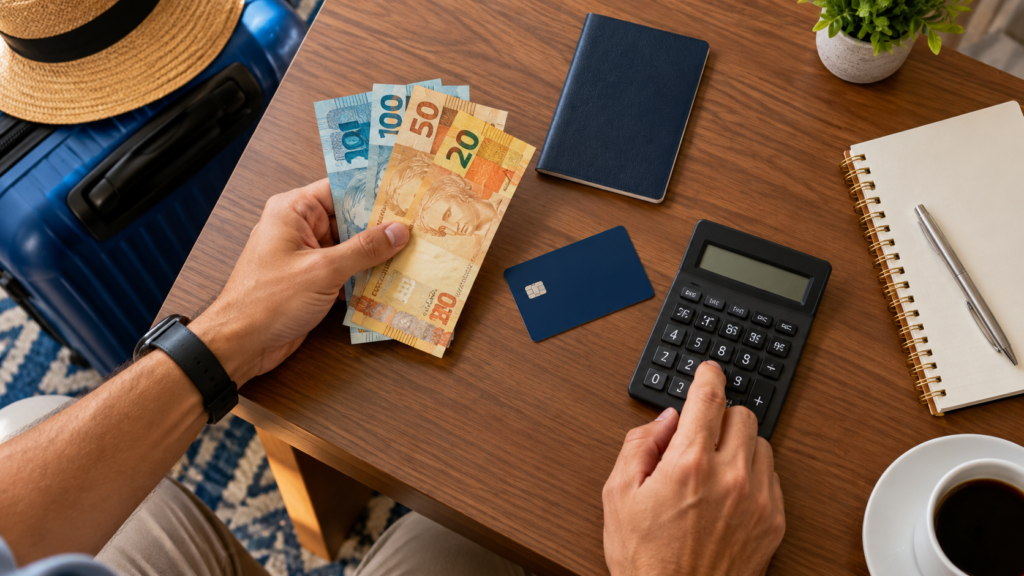
These items do not necessarily all apply together. A withdrawal with a Brazilian debit card and a balance in reais has different characteristics from a withdrawal with a foreign card or using the credit function.
How does the withdrawal fee work?
A withdrawal fee is a charge for the cash withdrawal service. It may apply per transaction, after a free allowance is used up, or according to the terms for using a particular network.
Brazilian demand deposit and savings accounts held by individuals include free essential services. According to Banco Central, these include four monthly withdrawals from checking accounts and two from savings accounts, subject to the regulatory terms.
This information should not automatically be extended to payment accounts, foreign accounts, or every type of card. Check your account’s classification and how the bank counts withdrawals made through your chosen network.
In addition, the allowance covers usage throughout the month. If you have already made withdrawals before the trip, you may have used part or all of the available allowance.
Does IOF apply to every withdrawal?
No. IOF is not a universal fee charged whenever someone uses an ATM. Whether it applies depends on the nature of the transaction, such as foreign exchange or credit, and its classification under the legislation.
The tax regulations distinguish between incoming and outgoing funds, spending with cards issued abroad, and other situations. Therefore, it is not correct to automatically apply the rule for Brazilians withdrawing cash abroad to foreign tourists withdrawing cash in Brazil.
With a global account, it is also important to identify at which stage any taxation occurred. The conversion used to fund the account and the subsequent withdrawal are separate steps.
To understand how your case is treated, consult the institution responsible for the account and request a breakdown of the amounts. Avoid adding an IOF percentage to your budget without confirming whether it applies.
What is the difference between currency conversion and the exchange rate spread?
Currency conversion changes the transaction amount from one currency to another. It may be necessary when you receive reais but your balance or card charge is in dollars, euros, or another currency.
The exchange rate spread is a markup built into the exchange rate relative to a reference rate. Depending on the product, this markup is already included in the price presented to the customer.
Therefore, do not add the spread again if it is already part of the exchange rate used in the estimate. The goal is to identify the effective cost without counting the same charge twice.
Can a credit card withdrawal involve other charges?
Before using the credit function, confirm how the issuer classifies the withdrawal. Depending on the agreement, it may be treated as a cash advance and involve a fee and interest.
Do not assume that withdrawing cash on credit has the same terms as making a purchase. Ask when charges begin, how repayment works, and what the total cost will be.
| Type of charge | When it may apply |
| Bank withdrawal fee | Depending on the account, allowance, and network used |
| Possible operator fee | When provided for that transaction |
| IOF | When the transaction falls into a taxable category |
| Currency conversion | When different currencies are involved |
| Exchange rate spread | When a markup is built into the conversion |
| Credit charges | When the withdrawal uses credit under the issuer’s terms |
Do ATM24h machines charge their own fee?
The cost of a withdrawal at ATM24h machines should be checked against the issuer’s terms and the information presented for the transaction. A card’s compatibility with the network does not, by itself, mean the withdrawal is free.
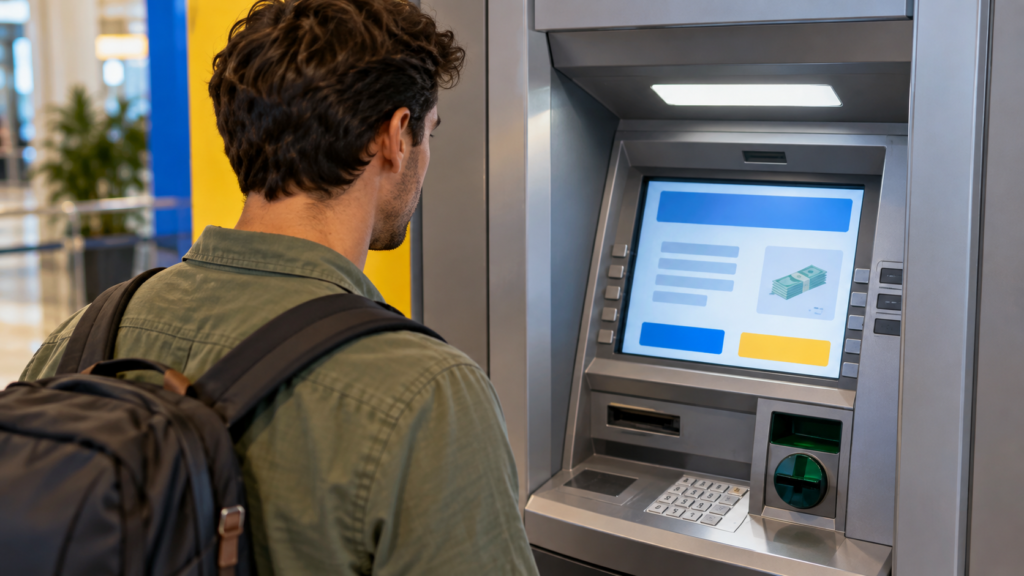
ATM24h states that it offers withdrawals in reais with domestic and international Visa and Mastercard cards. Completing the transaction also depends on the issuer’s authorization and the card’s terms.
To understand how much will be charged, distinguish three points:
- Issuer’s fee: check the app, fee schedule, or bank customer support.
- Possible charge displayed by the ATM: read the information before confirming.
- Conversion and additional charges: check the rules applicable to the account and card.
The public information consulted for this guide does not include a single schedule that would allow us to state an ATM24h operator fee for all cards and transactions. It would also be inappropriate to guarantee the absence of charges without checking the specific transaction.
Before traveling, ask your bank whether your card allows withdrawals in Brazil, which fees apply, and whether there is any policy for reimbursing operator charges.
When withdrawing cash, read the screen carefully. The amount displayed by the ATM should not automatically be understood as the full cost, since issuer charges may be recorded separately.
How can you find out how much will be charged before withdrawing cash?
Check the card issuer’s terms, verify your allowance, and read the ATM’s information before completing the withdrawal. For cards in foreign currencies, also check the conversion.
Ideally, do this before you need the cash. Having time to review the rules helps you avoid a rushed decision at the airport or during an outing.
Follow these steps:
- Open the app or online banking. Look for the fee schedule, card section, and withdrawal terms.
- Check your available allowance. See how many free withdrawals are included and how many you have already used.
- Identify the applicable fee. Confirm whether it differs between networks, countries, or transaction types.
- Check currency conversion. Find out the billing currency, exchange rate used, and possible markups.
- Check the limits. Review the daily limit, per-transaction limit, and available balance.
- Contact customer support if you have questions. Explain that you intend to withdraw reais in Brazil with that card.
- Read the ATM screen. Check the amount requested and any charge or conversion option displayed.
- Keep the receipt and check your statement. Compare the transaction entry with the terms provided by the bank.
A direct question for customer support is: “What costs will be charged if I withdraw reais in Brazil with this card, including fees, conversion, and any additional charges?”
The answer should help distinguish the amount withdrawn from the transaction expenses. If the bank provides only part of the cost, ask for the remaining components.
The limit also deserves attention. If the ATM or card requires the amount to be split into two withdrawals, a per-transaction fee may be applied more than once.
How can you reduce the costs of withdrawing cash in Brazil?
To reduce costs, check fees in advance, make use of available allowances, and plan the number of withdrawals. With international cards, also compare conversion terms.

The best plan depends on your itinerary. Someone making small cash purchases has different needs from someone spending several days in places where cards are not widely accepted.
Plan the number and amount of withdrawals
Avoid several small withdrawals when there is a fixed fee per transaction. Under this model, splitting the same amount across several withdrawals may increase the expense.
Consider this hypothetical example, which does not represent any bank’s or ATM24h’s fee schedule:
| Planning | Total amount received | Hypothetical fee per withdrawal | Total fees |
| Four withdrawals of R$ 150 | R$ 600 | R$ 10 | R$ 40 |
| Two withdrawals of R$ 300 | R$ 600 | R$ 10 | R$ 20 |
| One withdrawal of R$ 600 | R$ 600 | R$ 10 | R$ 10 |
The example considers only a fixed fee. It does not include conversion, taxes, charges, or amount restrictions.
Consolidating withdrawals only helps in this situation if the limits allow it. You also need to balance savings with safety: withdraw an amount suited to your planned expenses and avoid carrying unnecessary cash.
Compare international card terms
When evaluating a card for travel, look for information about:
- Fee per withdrawal.
- Number of free withdrawals.
- Amount limit included in the allowance.
- International transaction charges.
- Exchange rate and markup.
- Possible reimbursement of operator fees.
- Terms for using debit and credit.
A card with a lower withdrawal fee may have less favorable conversion terms. The comparison needs to consider all charges together.
Check any conversion offer on the screen
Some ATMs may offer billing in the card’s currency through dynamic currency conversion, known as DCC.
According to Visa, this offer should show amounts in both currencies, the exchange rate, and additional fees or markups. The user should be able to accept or decline conversion. Declining DCC does not, by itself, prevent a cash withdrawal.
Compare the offer with the issuer’s terms. If information is missing, do not confirm a conversion whose cost you cannot assess.
Monitoring exchange rates can help with planning but does not guarantee the rate actually used during processing. Use your card’s rules as a reference to estimate the expense.
Is it better to withdraw cash or exchange currency?
Withdrawing cash with an international card can be a convenient alternative to exchanging physical currency. The most economical option depends on the effective exchange rate, fees, and the amount you want to receive in reais.

A withdrawal allows you to use your card to receive local currency. A currency exchange office involves handing over foreign banknotes and receiving the corresponding amount in reais.
To compare, use the same basis: how much will you spend in your original currency to receive a given amount in reais?
| Withdrawal at ATM24h machines | Currency exchange office |
| Uses the traveler’s card | Involves exchanging physical foreign currency |
| Allows you to receive reais at network locations | Allows you to receive reais at the exchange establishment |
| Depends on balance or limit, compatibility, and authorization | Depends on the currency accepted and documentation requested |
| Costs vary by issuer, conversion, and transaction terms | Costs vary by exchange rate, fees, and applicable taxes |
| Access depends on the location where the ATM is installed | Service depends on the establishment’s opening hours |
The advertised exchange rate should not be considered in isolation. A fixed fee may have a greater impact on a small exchange, while a larger exchange rate markup may significantly affect higher amounts.
For foreign exchange transactions, Banco Central explains that the Total Effective Value, or VET, includes the exchange rate, IOF, and any fees charged. This concept helps compare offers with all components included.
Consider another hypothetical example: to receive R$ 1,000, one option requires a final expense of US$ 205 and another requires US$ 212. If all costs are included, the first uses US$ 7 less.
This comparison is more useful than looking only at expressions such as “no commission” or “free withdrawal.” They may refer to a specific charge while other costs still apply.
To exchange physical currency, seek an institution authorized to conduct foreign exchange transactions or its authorized agent. Confirm the net amount in reais before completing the transaction.
Where can you find ATM24h machines in Brazil?
ATM24h machines are located in airports, hotels, shopping centers, and other busy locations in different Brazilian cities. This distribution makes it easier to access reais during your trip.
ATM24h’s public client list includes airports such as Guarulhos, Galeão, Brasília, Salvador, and Foz do Iguaçu. The network also reports a presence in hotels and shopping centers.
| Airport | City or region served |
| Aeroporto Internacional de Guarulhos | Guarulhos and São Paulo |
| Aeroporto Internacional Tom Jobim, Galeão | Rio de Janeiro |
| Aeroporto Internacional de Brasília | Brasília |
| Aeroporto Internacional de Florianópolis | Florianópolis |
| Aeroporto Internacional de Salvador | Salvador |
| Aeroporto Internacional de Foz do Iguaçu | Foz do Iguaçu |
In Florianópolis, Floripa Airport itself lists ATM24h among its services.
Finding an ATM at the airport can make it easier to withdraw cash on arrival. This allows you to set aside money for expenses you already know will be paid in cash.
Before relying on a specific location, confirm where it is and its access conditions. A machine may be in a public area or in a section restricted to passengers.
Operation also depends on the establishment, machine availability, and card authorization. The network’s presence at the airport does not guarantee access to every ATM from every part of the terminal.
To organize your itinerary, consult Brasil ATM’s destination content and updated information from the airport, hotel, or shopping center where you intend to withdraw cash.
How can you avoid surprises with withdrawal fees?

To avoid surprises, learn your account’s terms before traveling and check each transaction before confirming it. The amount received in banknotes is only one part of the assessment.
ATM withdrawal fees in Brazil vary by issuer, card, allowance, and other transaction terms. When currency conversion is involved, the exchange cost also needs to be included in the budget.
At Brasil ATM, we recommend organizing this planning into three stages: check the rules before traveling, review the information during the withdrawal, and verify transaction entries afterward.
With these steps, you can identify charges, take advantage of available benefits, and decide how much cash you need for each part of your itinerary.
ATM24h machines offer a convenient way to withdraw reais in different Brazilian destinations. Planning withdrawals in advance helps combine cash access, expense control, and peace of mind during the trip.
Where to withdraw cash at ATM24h machines in Brazil
To make the most of your itinerary, it is best to carry cash. This ensures a smooth and incredible experience. In some places, cash is essential for food, transportation, attraction tickets, and more.
Check the table below for some 24-hour ATMs in the regions mentioned in this article:
| Where | Location |
| Aeroporto Internacional de Curitiba | See all locations here |
| Aeroporto Internacional de Guarulhos | See all locations here |
| Aeroporto Internacional do Rio de Janeiro | See all locations here |
| Aeroporto Santos Dumont | See all locations here |
Discover Brasil ATM
At Brasil ATM, we see Brazil as a place full of unique beauty and fascinating culture. Our portal, supported by the global brand ATM24h, reflects our love for Brazil. Our goal is to inspire tourists to explore its wonders safely and with reliable information.
We provide accurate, up-to-date, and inspiring information in three languages. With us, you will have everything you need to plan your trip with confidence. We offer travel guides, detailed itineraries, and useful planning tips.
We want to create lasting memories. We will show you Brazil’s natural and cultural beauty. Explore famous destinations such as Rio de Janeiro and São Paulo, and discover hidden gems such as Lençóis Maranhenses and Fernando de Noronha. We are here to help you make the most of your trip.
You may also enjoy reading:
- ATM at Rio de Janeiro airport: where to withdraw cash
- Best ATM to use in Brazil: how to withdraw cash safely
- ATM in Foz do Iguaçu: where to withdraw cash safely
- Where to find an ATM in Rio: a guide to withdrawing cash safely
Frequently asked questions about ATM withdrawal fees in Brazil
There is no single fee for all withdrawals. The cost depends on the institution, account, allowance, card, and network used. With foreign currency, conversion costs may also apply.
The issuer may charge a fee specified in the account or card agreement. Depending on the transaction, the ATM operator may also charge a fee. Check your bank’s terms and the information displayed by the ATM.
No. IOF depends on the transaction’s classification under the legislation. Its application should not be assumed simply because the card is international. Confirm with the institution which taxes are involved and at which stage they are charged.
Check the fee schedule, allowance, and conversion rules in the app or with bank customer support. Then read the ATM screen. Remember that issuer charges may appear separately on the statement.
It depends on the total cost of each option. Compare how much you will spend to receive the same amount in reais, including fees, conversion, and applicable taxes. Also consider service locations and availability.
ATM24h states that it supports international Visa and Mastercard cards. The withdrawal depends on product compatibility, activation for international use, available balance or limit, and authorization from the issuing institution.